

Thank you for Subscribing to Insurance Business Review Weekly Brief


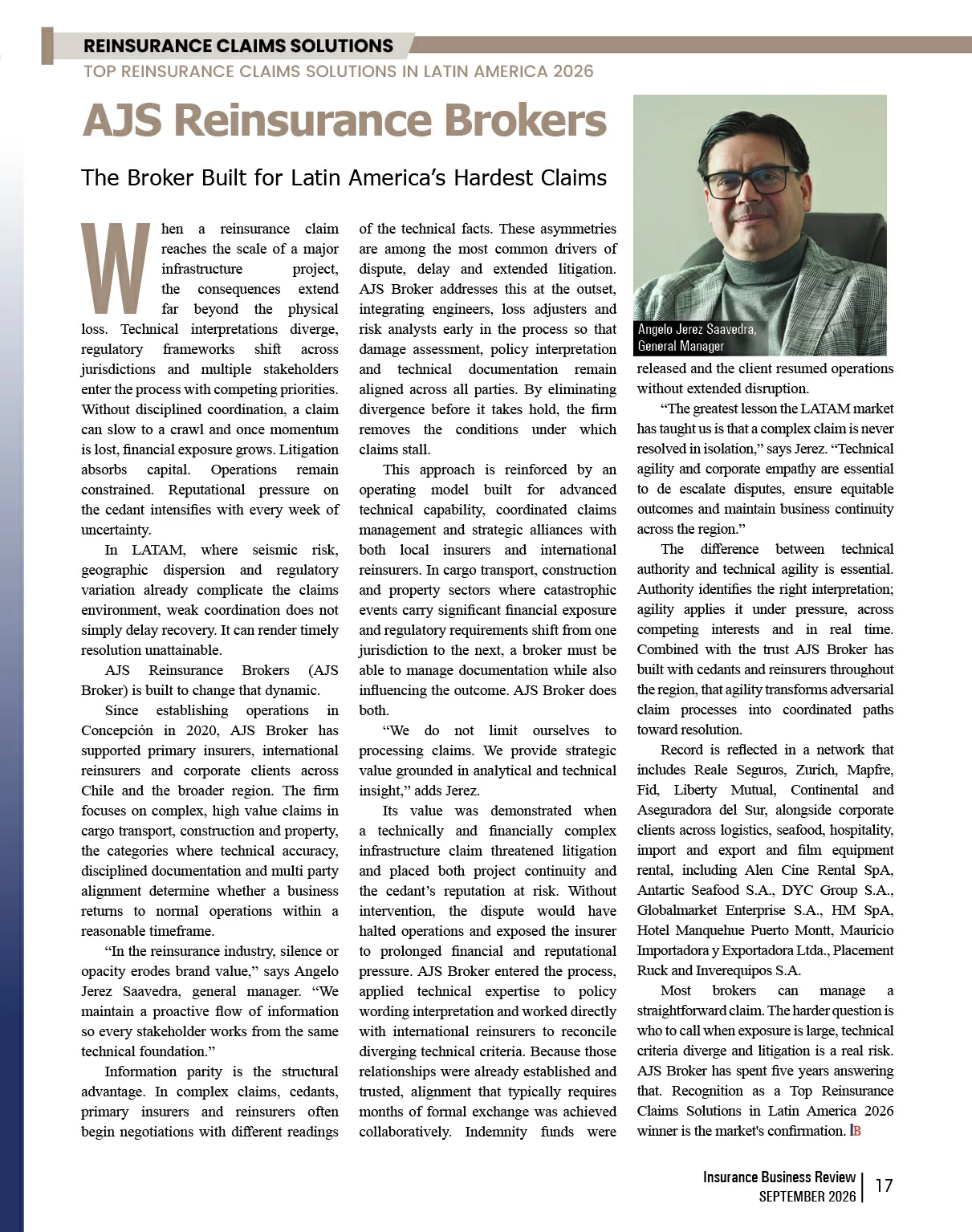
 Angelo Jerez Saavedra, General Manager
When a reinsurance claim reaches the scale of a major infrastructure project, the consequences extend far beyond the physical loss. Technical interpretations diverge, regulatory frameworks shift across jurisdictions and multiple stakeholders enter the process with competing priorities. Without disciplined coordination, a claim can slow to a crawl and once momentum is lost, financial exposure grows. Litigation absorbs capital. Operations remain constrained. Reputational pressure on the cedant intensifies with every week of uncertainty.
In LATAM, where seismic risk, geographic dispersion and regulatory variation already complicate the claims environment, weak coordination does not simply delay recovery. It can render timely resolution unattainable.
AJS Reinsurance Brokers (AJS Broker) is built to change that dynamic.
Since establishing operations in Concepción in 2020, AJS Broker has supported primary insurers, international reinsurers and corporate clients across Chile and the broader region. The firm focuses on complex, high value claims in cargo transport, construction and property, the categories where technical accuracy, disciplined documentation and multi party alignment determine whether a business returns to normal operations within a reasonable timeframe.
“In the reinsurance industry, silence or opacity erodes brand value,” says Angelo Jerez Saavedra, general manager. “We maintain a proactive flow of information so every stakeholder works from the same technical foundation.”
Information parity is the structural advantage. In complex claims, cedants, primary insurers and reinsurers often begin negotiations with different readings of the technical facts. These asymmetries are among the most common drivers of dispute, delay and extended litigation. AJS Broker addresses this at the outset, integrating engineers, loss adjusters and risk analysts early in the process so that damage assessment, policy interpretation and technical documentation remain aligned across all parties. By eliminating divergence before it takes hold, the firm removes the conditions under which claims stall.
-
In the reinsurance industry, silence or opacity erodes brand value. We maintain a proactive flow of information so every stakeholder works from the same technical foundation.
This approach is reinforced by an operating model built for advanced technical capability, coordinated claims management and strategic alliances with both local insurers and international reinsurers. In cargo transport, construction and property sectors where catastrophic events carry significant financial exposure and regulatory requirements shift from one jurisdiction to the next, a broker must be able to manage documentation while also influencing the outcome. AJS Broker does both.
“We do not limit ourselves to processing claims. We provide strategic value grounded in analytical and technical insight,” adds Jerez.
Its value was demonstrated when a technically and financially complex infrastructure claim threatened litigation and placed both project continuity and the cedant’s reputation at risk. Without intervention, the dispute would have halted operations and exposed the insurer to prolonged financial and reputational pressure. AJS Broker entered the process, applied technical expertise to policy wording interpretation and worked directly with international reinsurers to reconcile diverging technical criteria. Because those relationships were already established and trusted, alignment that typically requires months of formal exchange was achieved collaboratively. Indemnity funds were released and the client resumed operations without extended disruption.
“The greatest lesson the LATAM market has taught us is that a complex claim is never resolved in isolation,” says Jerez. “Technical agility and corporate empathy are essential to de escalate disputes, ensure equitable outcomes and maintain business continuity across the region.”
The difference between technical authority and technical agility is essential. Authority identifies the right interpretation; agility applies it under pressure, across competing interests and in real time. Combined with the trust AJS Broker has built with cedants and reinsurers throughout the region, that agility transforms adversarial claim processes into coordinated paths toward resolution.
Record is reflected in a network that includes Reale Seguros, Zurich, Mapfre, Fid, Liberty Mutual, Continental and Aseguradora del Sur, alongside corporate clients across logistics, seafood, hospitality, import and export and film equipment rental, including Alen Cine Rental SpA, Antartic Seafood S.A., DYC Group S.A., Globalmarket Enterprise S.A., HM SpA, Hotel Manquehue Puerto Montt, Mauricio Importadora y Exportadora Ltda., Placement Ruck and Inverequipos S.A.
Most brokers can manage a straightforward claim. The harder question is who to call when exposure is large, technical criteria diverge and litigation is a real risk. AJS Broker has spent five years answering that. Recognition as a Top Reinsurance Claims Solutions 2026 winner is the market's confirmation.
Reinsurance Claims Control for Latin American Insurance Markets
Large reinsurance claims expose the weakest part of an insurance program only after capital is already under pressure. A cedant may have purchased adequate cover, yet still face months of delay when policy wording, loss adjustment records, local regulation and reinsurer interpretation do not move in the same direction. In Latin America, that strain can become sharper because catastrophe exposure, infrastructure losses, cargo disruption and cross-border placement routinely cross technical boundaries. Executives buying reinsurance claims support are not simply buying claims administration. They are buying greater control over technical information and communication when settlement risk is already visible.
Many claims problems begin before a dispute is formal. Notifications are incomplete, supporting records arrive in fragments and reinsurers may interpret policy terms differently. Large losses in construction or transport also require people who can test the damage narrative rather than forward documents from one desk to another. Stronger providers bring engineers, loss adjusters and risk specialists close to the file early, so the claim is framed around verifiable facts before positions harden.
Communication discipline is a separate test. A primary insurer under pressure from a corporate client cannot wait for an opaque chain of messages among brokers, adjusters, cedants and reinsurance markets. Useful claims support keeps the same technical version of the file in front of each participant. It does not remove disagreement, but it narrows the space for avoidable friction. Consistent updates matter because gaps in communication can turn a technical disagreement into a broader client relationship problem.
" Claims work still depends on who can convene the right experts and maintain credibility with reinsurers when commercial pressure rises. "
Contract interpretation is another dividing line. Reinsurance claims are rarely settled by general brokerage instincts once a significant loss enters the file. Buyers should look for teams comfortable reading complex contracts within different legal frameworks, preserving the documentary trail, translating adjuster findings into clear technical arguments and knowing when a claim needs legal, engineering, financial and underwriting input. Weak service models treat complexity as escalation. Better models organize complexity from the start, which can reduce litigation pressure without pretending every claim will be easy.
Regional capability also deserves closer scrutiny. A claims partner may understand reinsurance mechanics yet struggle when a file involves port delays, construction evidence, natural-hazard damage and documentation standards expected by international reinsurance markets. The buyer’s question is whether the provider can bridge local fact gathering with global market expectations. Scale alone is not the answer. Claims work still depends on who can convene the right experts and maintain credibility with reinsurers when commercial pressure rises.
AJS Broker provides reinsurance claims support built around technical expertise, coordinated claims management and close communication across the parties involved in a loss. Its model combines contract analysis, specialist technical support and risk management tools with relationships across insurers and international reinsurance markets. The approach is particularly relevant to claims involving construction, cargo transport, property and major infrastructure losses, where engineers, loss adjusters and risk analysts can help establish the technical facts behind a claim. AJS keeps cedants, local brokers and international reinsurance markets working from the same technical information as a claim progresses, helping reduce unnecessary friction and giving settlement discussions a clearer foundation. For insurers dealing with complex losses, that coordination turns claims broking from an administrative function into an active part of business recovery.
...Read more
Reinsurance Claims Solutions in Latin America Info
Q1
What Are Reinsurance Claims Solutions in Latin America?
Reinsurance Claims Solutions in Latin America help insurers, cedants and other stakeholders manage complex losses where technical evidence, policy interpretation, regulatory requirements and multiple parties must be coordinated. The need becomes especially important in large construction, cargo, property and infrastructure claims, where delays can increase financial and operational pressure. Effective claims support brings technical specialists and stakeholders together around consistent information, helping create a clearer path toward settlement and recovery.
Q2
How Does AJS Reinsurance Brokers Approach Reinsurance Claims Solutions in Latin America?
AJS Reinsurance Brokers focuses on complex, high-value claims across cargo transport, construction and property. Its approach brings engineers, loss adjusters and risk analysts into the process early, allowing damage assessment, policy interpretation and supporting documentation to develop from a shared technical foundation. The firm also works with primary insurers, international reinsurers and corporate clients, using established relationships to coordinate discussions when technical positions diverge.
Q3
What Problems Can Reinsurance Claims Solutions in Latin America Help Address?
Reinsurance Claims Solutions in Latin America can help address incomplete documentation, conflicting technical interpretations, communication gaps and delays between cedants, insurers, brokers, adjusters and reinsurers. These issues can become particularly difficult when a loss crosses technical or regulatory boundaries. A coordinated claims model helps maintain consistent information across participants and can reduce avoidable friction before disagreements develop into prolonged disputes or litigation.
Q4
Why Is Technical Expertise Important in Complex Reinsurance Claims?
Technical expertise gives Reinsurance Claims Solutions in Latin America a stronger basis for evaluating damage, interpreting policy wording and presenting evidence. Significant claims may require engineering findings, loss-adjustment records, financial analysis and contractual interpretation to work together. AJS Reinsurance Brokers applies this multidisciplinary approach to establish technical facts early and reconcile differing criteria among stakeholders, particularly in complex infrastructure and property-related losses.
Q5
What Should Organizations Evaluate When Choosing Reinsurance Claims Solutions in Latin America?
Organizations should examine a provider’s ability to coordinate technical specialists, preserve documentation, interpret complex contracts and communicate consistently across local and international stakeholders. Regional capability also matters because claims may involve local regulations and evidence requirements alongside expectations from international reinsurance markets. Reinsurance Claims Solutions in Latin America are most useful when they can bridge those requirements without reducing claims management to administrative processing.
Q6
How Does AJS Reinsurance Brokers Support Business Continuity Through Claims Management?
When major losses put operations under financial or reputational pressure, AJS Reinsurance Brokers uses Reinsurance Claims Solutions in Latin America to help move claims toward resolution. In one infrastructure claim, the firm helped reconcile differing technical criteria with international reinsurers and supported the release of indemnity funds, helping the client resume operations without prolonged disruption. The approach brings together claims management, technical analysis and clear communication among the parties involved.
