

Thank you for Subscribing to Insurance Business Review Weekly Brief


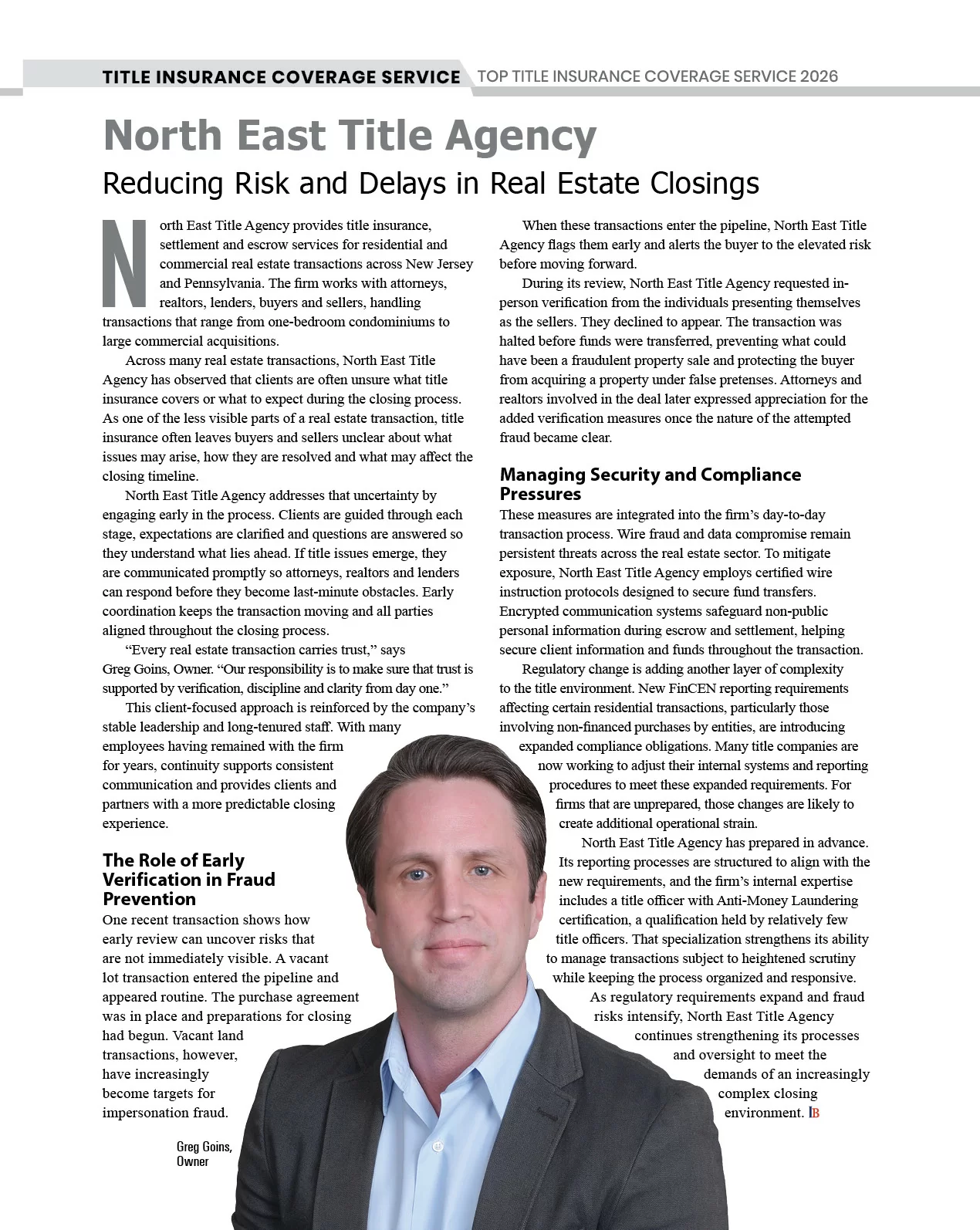
 Greg Goins, Owner
What challenges do clients face in understanding title insurance and closing processes?
North East Title Agency provides title insurance, settlement and escrow services for residential and commercial real estate transactions across New Jersey and Pennsylvania. The firm works with attorneys, realtors, lenders, buyers and sellers, handling transactions that range from one-bedroom condominiums to large commercial acquisitions.
Across many real estate transactions, North East Title Agency has observed that clients are often unsure what title insurance covers or what to expect during the closing process. As one of the less visible parts of a real estate transaction, title insurance often leaves buyers and sellers unclear about what issues may arise, how they are resolved and what may affect the closing timeline.
How does early engagement help prevent delays and align stakeholders in real estate transactions?
North East Title Agency addresses that uncertainty by engaging early in the process. Clients are guided through each stage, expectations are clarified and questions are answered so they understand what lies ahead. If title issues emerge, they are communicated promptly so attorneys, realtors and lenders can respond before they become last-minute obstacles. Early coordination keeps the transaction moving and all parties aligned throughout the closing process.
“Every real estate transaction carries trust,” says Greg Goins, Owner. “Our responsibility is to make sure that trust is supported by verification, discipline and clarity from day one.”
This client-focused approach is reinforced by the company’s stable leadership and long-tenured staff. With many employees having remained with the firm for years, continuity supports consistent communication and provides clients and partners with a more predictable closing experience.
The Role of Early Verification in Fraud Prevention
Why is early verification critical in identifying fraud risks in vacant property transactions?
One recent transaction shows how early review can uncover risks that are not immediately visible. A vacant lot transaction entered the pipeline and appeared routine. The purchase agreement was in place and preparations for closing had begun. Vacant land transactions, however, have increasingly become targets for impersonation fraud.
When these transactions enter the pipeline, North East Title Agency flags them early and alerts the buyer to the elevated risk before moving forward.
-
Every real estate transaction carries trust. Our responsibility is to make sure that trust is supported by verification, discipline and clarity from day one.
During its review, North East Title Agency requested in-person verification from the individuals presenting themselves as the sellers. They declined to appear. The transaction was halted before funds were transferred, preventing what could have been a fraudulent property sale and protecting the buyer from acquiring a property under false pretenses. Attorneys and realtors involved in the deal later expressed appreciation for the added verification measures once the nature of the attempted fraud became clear.
Managing Security and Compliance Pressures
In what way does regulatory preparedness support compliance and transaction security in title services?
These measures are integrated into the firm’s day-to-day transaction process. Wire fraud and data compromise remain persistent threats across the real estate sector. To mitigate exposure, North East Title Agency employs certified wire instruction protocols designed to secure fund transfers. Encrypted communication systems safeguard non-public personal information during escrow and settlement, helping secure client information and funds throughout the transaction.
Regulatory change is adding another layer of complexity to the title environment. New FinCEN reporting requirements affecting certain residential transactions, particularly those involving non-financed purchases by entities, are introducing expanded compliance obligations. Many title companies are now working to adjust their internal systems and reporting procedures to meet these expanded requirements. For firms that are unprepared, those changes are likely to create additional operational strain.
North East Title Agency has prepared in advance. Its reporting processes are structured to align with the new requirements, and the firm’s internal expertise includes a title officer with Anti-Money Laundering certification, a qualification held by relatively few title officers. That specialization strengthens its ability to manage transactions subject to heightened scrutiny while keeping the process organized and responsive.
As regulatory requirements expand and fraud risks intensify, North East Title Agency continues strengthening its processes and oversight to meet the demands of an increasingly complex closing environment.
Gold Standard Evaluation for Title Insurance Coverage Services
Title insurance remains one of the least understood yet most consequential elements in real estate transactions. Executives responsible for acquiring top title insurance coverage services must balance regulatory exposure, fraud risk and transactional timing against client experience and fiduciary duty. In both commercial and residential markets, the title function sits at the center of legal compliance, capital movement and reputational accountability. A lapse in diligence can derail closings, expose counterparties to financial loss or create downstream litigation risk.
Market conditions have intensified scrutiny. Escalating wire fraud, identity theft schemes and fraudulent vacant land transfers have introduced new layers of vulnerability. Regulatory developments such as FinCEN reporting requirements add further compliance obligations, particularly in transactions that are not financed by major lending institutions or that involve non-individual buyers. Title providers must now demonstrate not only procedural competence but disciplined risk management frameworks capable of anticipating and mitigating emerging threats.
Executives evaluating title insurance coverage services should begin with transparency and client education. Many buyers and sellers lack clarity around what title insurance protects against and how defects are resolved. A provider that establishes expectations early, explains contingencies and proactively communicates potential encumbrances reduces friction across the transaction lifecycle. Early disclosure of title issues, rather than last-minute discovery, preserves trust among attorneys, lenders and real estate professionals while protecting closing timelines.
Coordination is equally critical. A high-performing title agency must operate as an integrated partner with attorneys, realtors and lenders to ensure alignment. Disjointed communication introduces delays and elevates risk. Consistent updates, shared documentation protocols and defined escalation procedures form the backbone of reliable closings across both small residential transfers and large commercial acquisitions.
Fraud prevention capability has become a defining evaluation criterion. Certified wire instruction processes, encrypted communication platforms and identity verification protocols should be baseline requirements. Vacant lot transactions in particular demand heightened scrutiny, as impersonation schemes frequently target such properties. A title agency that flags these transactions early, verifies seller identity through direct confirmation and refuses to proceed when discrepancies arise demonstrates a governance mindset that protects capital and reputation. Preventing a fraudulent transfer is not merely a procedural win; it safeguards investors from irreversible loss.
Escrow administration and settlement execution also warrant close examination. Secure fund handling, vendor quality and documented controls determine whether capital is transmitted accurately and without exposure. Encryption standards, secure messaging and documented workflows signal maturity in data protection. Given the scale of losses reported annually from real estate fraud, executives cannot treat these safeguards as optional enhancements.
Regulatory preparedness further differentiates leading providers. FinCEN reporting obligations introduce operational complexity that many agencies may struggle to absorb. A title firm that has already implemented reporting systems and retains internal anti-money laundering expertise signals forward readiness. Compliance capability should extend beyond reactive adherence to include structured reporting protocols embedded within transaction workflows.
Organizational continuity influences performance. Experienced personnel, stable leadership and long-standing internal collaboration contribute to smoother execution. High staff retention reduces procedural errors and supports consistent communication standards across transactions of varying size and complexity.
North East Title Agency merits consideration under these criteria. It conducts both residential and commercial closings in New Jersey and Pennsylvania and integrates early client outreach into its process to clarify expectations and surface potential title defects. Its escrow and settlement services are supported by certified wire instruction procedures and encrypted communication systems designed to counter fraud exposure. The firm proactively flags vacant lot transactions and verifies seller identity through direct confirmation steps, declining to proceed when impersonation risk is detected. It has also established internal processes to address FinCEN reporting requirements and employs a title officer with anti-money laundering certification to reinforce compliance oversight.
For executives prioritizing disciplined fraud mitigation, regulatory readiness and structured client guidance within title insurance coverage services, North East Title Agency represents a prudent, risk-aware choice.
...Read more
Title Insurance Coverage Services Info
Q1
What Do Title Insurance Coverage Services Protect in a Real Estate Closing?
Title Insurance Coverage Services help protect buyers and lenders from ownership problems that may not surface until after a transaction is underway. Those problems can include liens, recording mistakes, unpaid obligations or unclear ownership history. Good coverage work reduces the chance that a closing is delayed by title defects or that a buyer receives property with unresolved claims attached.
Q2
How Does North East Title Agency Support Clear Property Transfers?
North East Title Agency provides Title Insurance Coverage Services and settlement services for real estate transactions in New Jersey. It works with attorneys, lenders and real estate agents to help close title on time and transfer ownership free and clear, without clouds on title. That matters because even a small documentation gap can slow a closing or create uncertainty after purchase.
Q3
What Should Buyers Review Before Choosing a Title Coverage Provider?
Buyers should look at how a provider handles title searches, communication, settlement coordination and document access. Title Insurance Coverage Services should make it easier to spot title issues early, explain the next step clearly and keep sensitive transaction information organized. A useful test is whether the provider can coordinate with the buyer’s attorney, lender and real estate agent without creating extra email chains or missed updates.
Q4
Why Does Secure Document Access Matter During Settlement?
Real estate closings involve private financial and personal information. Title Insurance Coverage Services should protect that information while keeping the transaction moving. North East Title Agency gives clients private online access to important documents and information, reducing the need to share sensitive material by email. Its order process also lets customers submit basic transaction details before an agent follows up with more information and a quote.
Q5
How Do Settlement Services Fit Into Title Coverage Work?
Settlement services connect the title review to the actual closing. Title Insurance Coverage Services are not only about issuing a policy; they also depend on timing, payoff coordination, document preparation and clear communication among the parties involved. When those steps are handled carefully, buyers and lenders have a cleaner path from title review to signed closing documents.
Q6
What Makes Title Coverage Valuable After Closing?
The value of Title Insurance Coverage Services continues after the transaction is complete. A policy can help address covered ownership disputes that trace back to issues before the buyer took title. The best providers treat coverage, settlement and documentation as one connected process, because buyers need confidence not only that the closing happened, but that ownership was transferred with fewer unresolved risks.
